Visualise scatter
Explore simulated scatter relationships that would otherwise be invisible during clinical work.
Train interventional cardiology teams to practise ALARA principles, dose reduction, shielding, positioning, and fluoroscopy workflow decisions in a risk-free VR simulation environment.
Request a RadSafeVR demo:
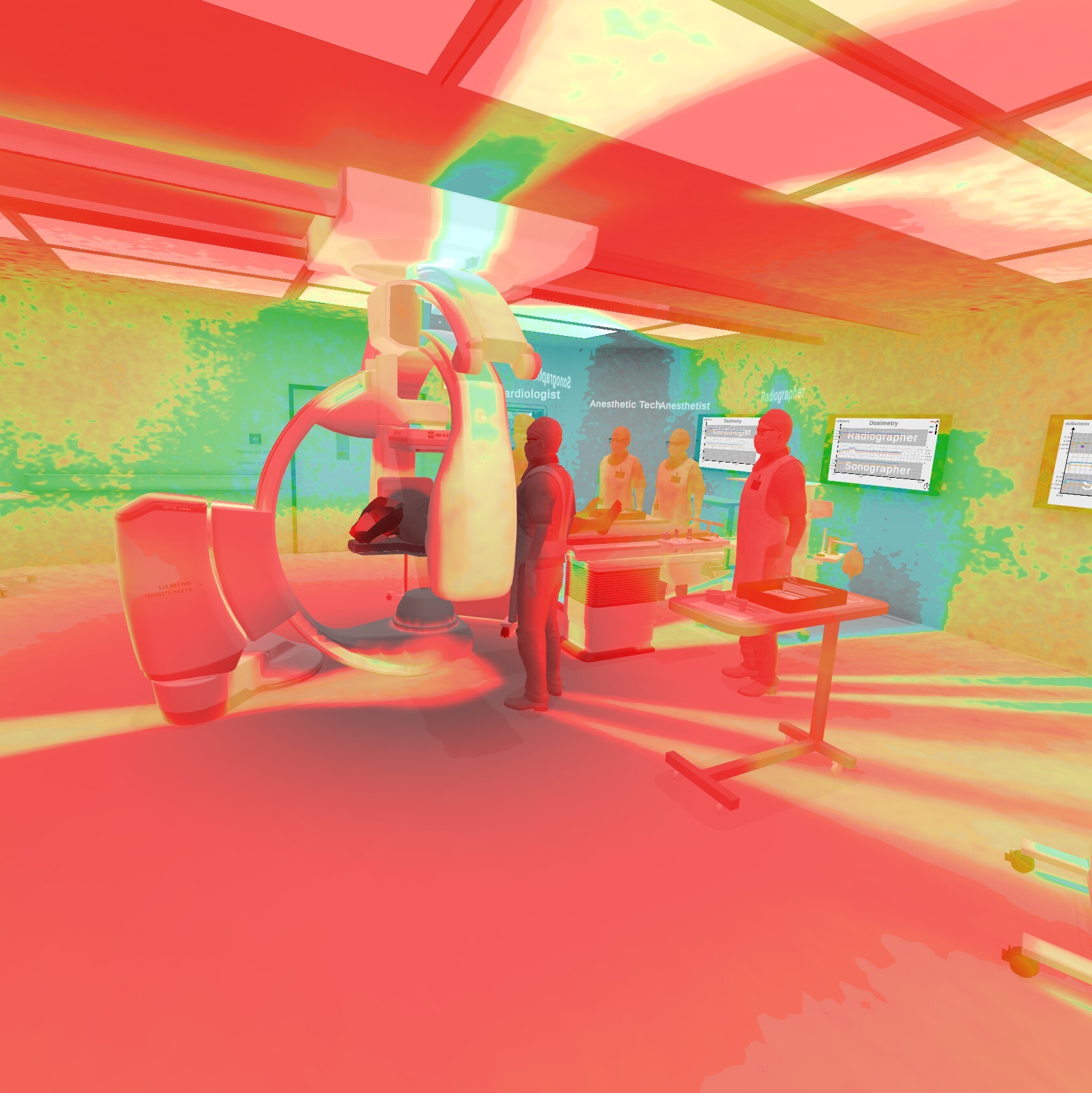
RadSafeVR helps learners connect ALARA principles with real clinical behaviour. Learners can see scatter radiation, practise shielding and positioning, understand equipment geometry, and repeat scenarios safely before applying those behaviours in live fluoroscopy-guided procedures.
Learners see how staff position affects occupational exposure during fluoroscopy-guided procedures.
Learners practise the effect of ceiling-suspended shields, table shielding, eyewear, and protective positioning.
Learners identify safer and higher-risk positions around the patient, table, tube, and image receptor.
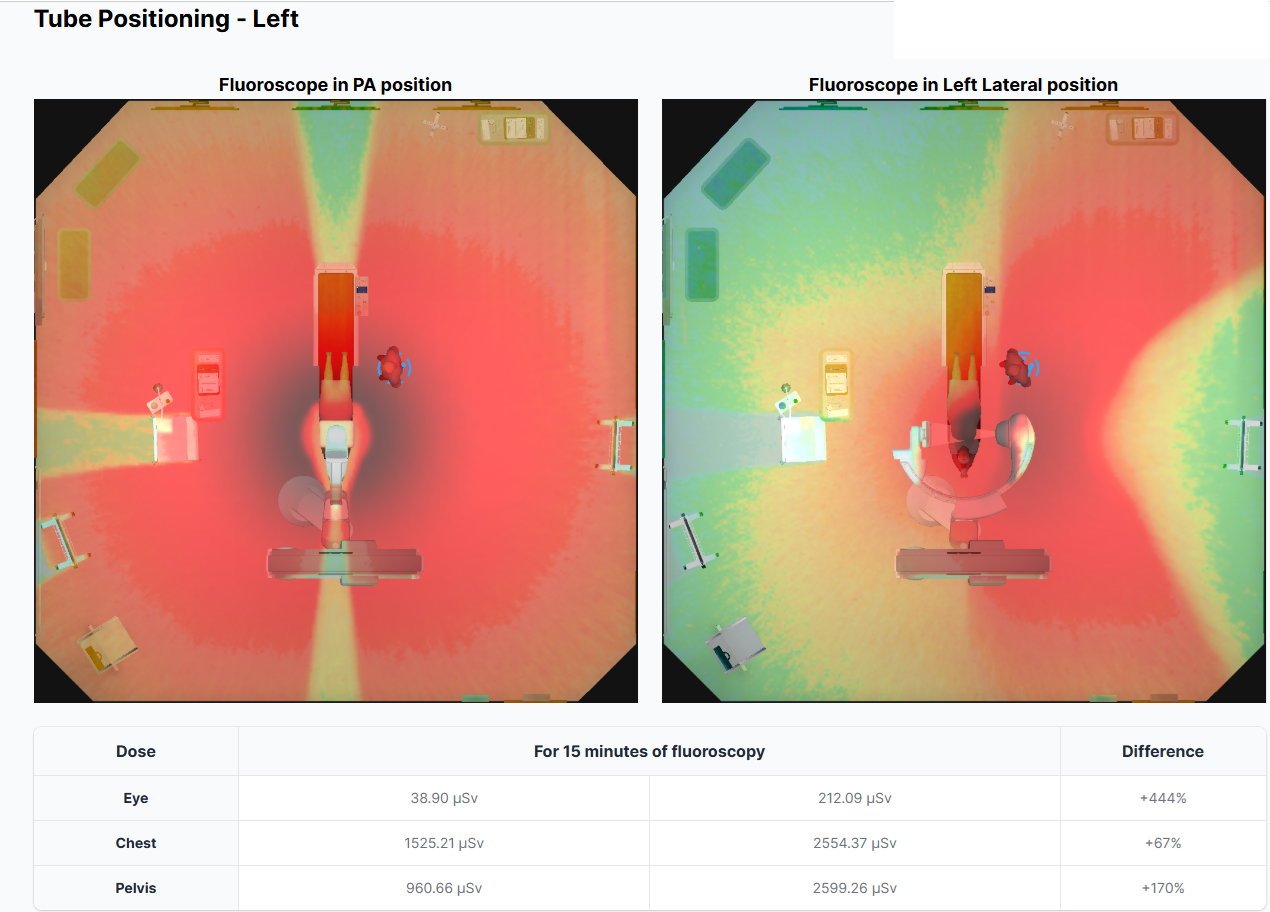
Learners see how equipment geometry and tube position affect scatter distribution.
Learners connect workflow choices with dose awareness, image acquisition, and team communication.
Learners receive visual and measurable feedback and can repeat scenarios safely.
Evidence base
Current evidence supports virtual reality as an educational and practice tool for radiation protection. Several published clinical studies using RadSafeVR have also reported reductions in measured occupational radiation exposure following structured VR training.
International guidance places education and training within a wider occupational radiation-protection programme. This includes exposure monitoring, appropriate shielding, equipment-specific instruction, optimisation, quality assurance, local policies and professional oversight. 1, 2
Explore simulated scatter relationships that would otherwise be invisible during clinical work.
Compare positions around the patient, table, X-ray tube and image receptor.
Practise positioning protective barriers in relation to the simulated scatter field.
Examine how tube position, beam angulation and equipment geometry affect simulated scatter distribution.
Review decisions made during each scenario and identify areas for further practice.
Repeat scenarios without exposing learners or patients to ionising radiation during the simulation.
Published RadSafeVR research
Cardiology and scrub nurses
Rezaei and colleagues studied 150 cardiologists and scrub nurses across five hospitals. VR training produced a 30% greater decrease in radiation dose than traditional training and improved knowledge retention and practical assessment performance.3
Medical professionals
Mwangi and Tanaka studied 39 professionals from cardiac catheterisation laboratories and orthopaedic theatres. RadSafeVR training was associated with significant reductions in radiation exposure and higher satisfaction, engagement and confidence than didactic training.4
Interventional radiology nurses
Khamis, Bello and Abdullahi evaluated VR radiation-safety training among interventional radiology nurses. The study reported substantial and sustained reductions in occupational exposure following immersive VR training.5
Continuing medical education
Takahashi, Nakamura and Fujiwara studied 36 healthcare professionals. VR training improved knowledge retention by 30% at three months, reduced occupational eye-dose exposure by 25%, and was preferred by 85% of participants.6
Cardiac catheterisation scrub nurses
Romanenko and colleagues studied 100 scrub nurses over 18 months. VR training produced significantly greater reductions in radiation dose across the eyes, chest and pelvis than traditional training, with evidence of a sustained carryover effect.7
Radiography and medical students
Rainford and colleagues evaluated a three-dimensional VR radiation-protection resource with radiography and medical students. Participants generally viewed the experience positively, reported increased confidence and considered VR a valuable learning and assessment tool. This study examined learner perceptions rather than measured clinical dose.8
Important limitation: These studies support dose reduction and educational benefits within the clinical and educational settings that were studied. They do not guarantee that every department will achieve the same result. Outcomes depend on equipment, procedure mix, workload, staff roles, shielding, departmental practice and whether learned behaviours transfer into clinical work. RadSafeVR should be used as part of a wider radiation-protection programme, not as a replacement for local governance, personal dosimetry or supervised clinical practice.
Evidence reviewed: 18 August 2026
See how your team can practise shielding, staff positioning, fluoroscopy workflow decisions, and dose awareness in a safe VR simulation environment.
Radiation safety training for interventional cardiology teaches cardiologists, fellows, nurses, radiographers, and technologists how to reduce occupational exposure during fluoroscopy-guided procedures. It should cover ALARA principles, shielding, staff positioning, dose awareness, and workflow decisions
RadSafeVR can do more than replace a passive classroom session. The full RadSafeVR programme combines adaptive self-assessment, adaptive learning, simulation-based practice, and certification of completion or competence. Classroom teaching can still be useful for local policy, regulatory context, and department-specific procedures, but RadSafeVR provides the practical training layer where learners apply ALARA principles, practise shielding and positioning, receive feedback, and demonstrate competence in a simulated environment.
Yes. Radiation Safety Officers and educators can access dashboards showing learner progress, simulation activity, assessment outcomes, and evidence of completion or competence. This helps institutions move radiation safety training from passive attendance to documented, measurable practice.
The training is relevant and individually designed for interventional cardiologists, fellows, scrub nurses, radiographers, cardiac technologists, and other team members who work in or around fluoroscopy-guided procedures
Institutions usually align refresher training with local radiation safety policies, onboarding requirements, and continuing professional development expectations. VR can support annual refreshers, new staff onboarding, and competency checks.
VR radiation safety training can help learners understand and practise behaviours associated with dose reduction, including shielding, positioning, distance, and fluoroscopy workflow decisions. Peer-reviewed studies of RadSafeVR and VR radiation safety training have reported reductions in measured occupational dose after VR-based training.
Yes. RadSafeVR is designed for institutional healthcare education and training environments, including universities, hospitals, and clinical education teams that need structured learner access, repeatable scenarios, and educator oversight.