VR Healthcare Simulation Solutions for Radiography, Radiation Safety, and Midwifery
VR Healthcare Simulation Solutions for Radiography, Radiation Safety and Midwifery
Virtual Medical Coaching develops immersive VR healthcare simulation platforms for radiography training, radiation safety education and midwifery simulation. Our solutions support universities and healthcare institutions with structured, curriculum-aligned clinical training.
Our simulation capabilities include:
• Radiography simulation with beam alignment, patient positioning and image evaluation
• Occupational radiation safety and dosimetry training
• Midwifery and childbirth scenario training aligned to clinical curricula
Our platforms are available in both VR and desktop formats.
X-Ray Pro VR Suite for Radiography Education
X-Ray Pro VR Suite enables students to simulate X-ray positioning, beam alignment, exposure selection, and image evaluation in a structured virtual environment. Learners receive immediate feedback on positioning accuracy, collimation, and image quality before entering clinical placement.
The platform supports curriculum-aligned radiography training for universities and teaching hospitals, helping students develop technical competence through repeatable practice without patient risk.
X-Ray Pro VR Suite is available in both VR and desktop formats to support flexible delivery across classroom, laboratory, and remote learning environments.
Learning Outcomes
Students using X-Ray Pro VR Suite develop competence in:
Patient Positioning Accuracy
Position patients for standard and non-standard radiographic projections with immediate visual feedback on anatomical alignment and positioning errors.
Exposure Parameter Selection
Apply appropriate exposure factors based on anatomy, projection and patient characteristics, reinforcing principles of image quality and dose optimisation.
Beam Alignment and Centring
Practise accurate beam alignment and centring to anatomical landmarks, improving consistency and reducing repeat imaging.
Image Quality Evaluation
Critically assess radiographic images against accepted clinical criteria, identifying positioning errors, exposure issues and artefacts.
Error Recognition and Correction
Identify common radiographic errors and understand their causes, enabling learners to correct technique prior to clinical placement.
Preparation for Clinical Placement
Build technical confidence and procedural fluency in a simulated X-ray environment before performing examinations on real patients.
.png?width=500&height=396&name=Radiation%20Safety%20(1).png "Radiation Safety")
RadSafe VR for Occupational Radiation Safety Education
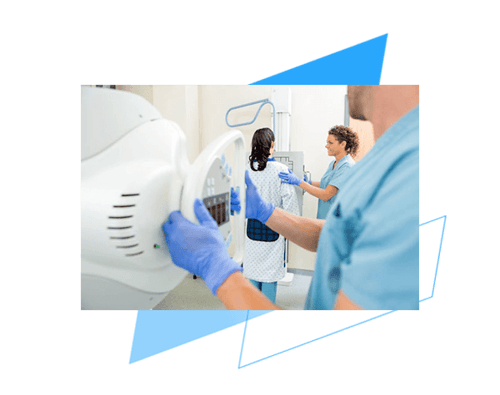
RadSafe VR enables clinicians and trainees to simulate occupational radiation exposure, scatter distribution, and protective shielding in interventional, cardiology, and imaging environments. Learners visualise dose accumulation in real time and explore how positioning, beam angulation, and shielding affect operator exposure.
The platform supports radiation safety training for cardiology, interventional radiology, and imaging departments, reinforcing ALARA principles and safe clinical practice.
RadSafe VR is available in both VR and desktop formats to support structured teaching, workshops, and ongoing professional development.
Learning Outcomes
Students and clinicians using RadSafe VR develop competence in:
Balancing Dose and Image Quality
Apply the ALARA principle to minimise radiation exposure while maintaining diagnostic image quality.
Dose Limitation Techniques
Use magnification control, collimation, wedge filters, and procedural adjustments to limit radiation exposure to non-target tissues.
Dose Reduction in Challenging Scenarios
Implement strategies to reduce radiation dose during steep beam angulation and when imaging larger patients.
Recognising High-Dose Situations
Identify when and why elevated radiation doses occur during clinical procedures.
Staff Position Awareness
Evaluate staff positioning relative to the primary beam and scatter radiation to reduce occupational exposure.
Protective Equipment and Shielding
Apply appropriate use of personal protective equipment and shielding to reduce occupational radiation exposure.
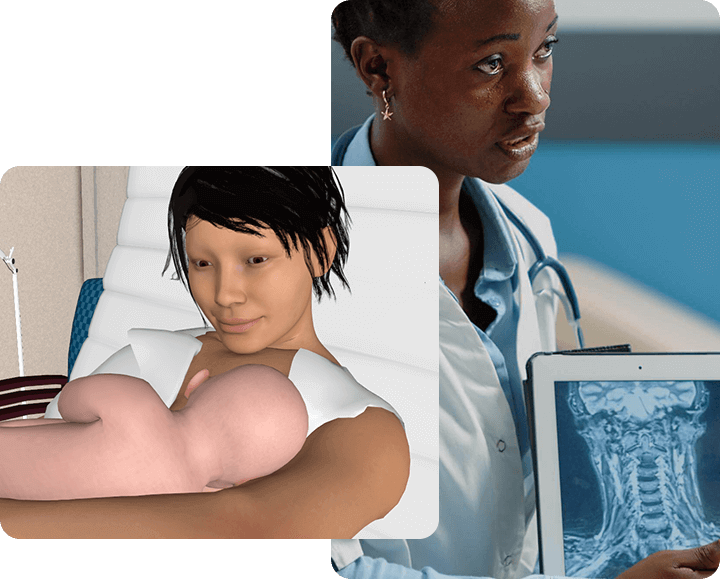
BirthWise VR: Virtual Reality Simulation for Midwifery Education
BirthWise VR provides structured simulation for midwifery and childbirth education within a realistic labour ward environment. Learners practise clinical assessment, communication, decision-making and emergency response in scenarios aligned with maternity care curricula.
The platform supports midwifery students and clinical educators by enabling repeatable practice of labour management, maternal monitoring and newborn care before supervised clinical placement.
BirthWise VR is available in both VR and desktop formats to support classroom teaching, simulation labs and remote learning delivery.
Learning Outcomes
Students using BirthWise VR develop competence in:
Labour Assessment and Monitoring
Assess labour progression, maternal observations and fetal wellbeing using structured clinical reasoning.
Clinical Decision-Making
Apply appropriate interventions based on maternal condition, labour stage and emerging complications.
Communication in Maternity Care
Demonstrate effective communication with patients, families and multidisciplinary teams during routine and complex scenarios.
Emergency Recognition and Response
Identify obstetric emergencies and initiate appropriate escalation and management strategies.
Newborn Care Fundamentals
Perform initial newborn assessment and implement immediate post-birth care procedures.
Professional Confidence in Clinical Settings
Develop procedural fluency and decision-making confidence prior to real-world maternity placements.